
Thriving Families. Thriving Communities.
“Caring for our children and families, watching them grow and thrive – that means so much to me. They carry so much and if I can carry some of that, even for a short time, it makes all the difference.”
-Kyslanie, Community Health Worker, Pediatrics
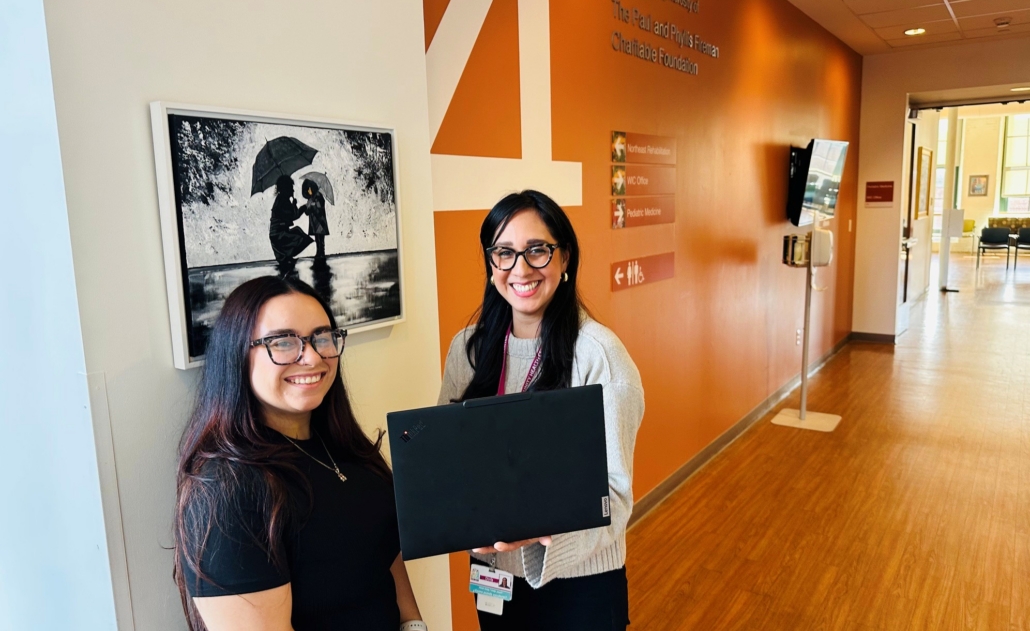
Meet Kyslanie and Dina, part of a team of Community Health Workers who provide care coordination and resource support for thousands of our pediatric patients and their families.
“Every day is a little different,” Dina says. “Sometimes I’m on the phone with a child’s school, sometimes a doctor or nurse pulls me in to talk to a family if they pick up on something during an appointment. I’m here for whatever our families need.”
At any point in time, Dina and Kyslanie can be coordinating support for 200+ families – from referrals to community resources, like WIC, to patients requiring care for complex conditions. Much of their work centers around childhood nutrition and wellness and support for autism and other behavioral health needs.
Our team focuses on early intervention so families can access the continuum of services available. This starts with helping parents navigate increasingly complex systems – not designed for busy, working families.
“We’ve done this hundreds of times. For most parents this is a new experience. Multiple appointments, referrals to specialists, confusing conversations with the child’s school. Sometimes there are barriers, like language, access to systems and technology. We bring calm, confidence and the answers they need,” Dina explains.
Over many years, and hundreds of patients, Dina and Kyslanie have developed strong partnerships with the Lowell Public Schools, Early Intervention services, local therapy providers, even Northeast Rehab, who provides feeding therapy right here in our building.
“We are on a first name basis,” Dina says, smiling. “We are all on the same team, supporting these kids.”
2 years ago, Lowell CHC launched its own Autism Clinic, a pilot program in response to the high demand, and long waits for accessing diagnostic and support services in Boston. To date, nearly 70 families have benefitted from this in-depth, multi-visit process. While barriers still exist, patients diagnosed here can quickly connect with Dina and begin therapy as soon as possible – building trust during what can be a difficult moment for any parent.
Recently, Kyslanie was working to support a child who was 2 years old and still not speaking, but was too old for Early Intervention services through the state. She had worked to find an alternative provider who would accept their insurance, but it was far from home, requiring transportation support. With persistence and collaboration, our team worked out a solution with the therapy center to make sure the child could get to her appointments – and continue her progress.
“The truth is, if we didn’t have these services a lot of kids would get lost to care, a lot of families – they would just not get the help they need,” says Kyslanie.
For some families, that support may be one conversation, one referral. For others, it may take longer. Dina and Kyslanie follow their lead. Some of the best moments are when they hear from a parent, months or even years later, sharing stories of progress and growth – or just saying hello.
“I’m grateful to walk alongside patients, giving them the strength, the tools to advocate for themselves, is the best reward,” Dina shares. “When a family says, ‘I got this – I can do this on my own’ those are some of the best moments.”
Photo caption: Kyslanie (left) and Dina (right), Community Health Workers